


How to Choose the Right Vapor Degreasing Machine for Your Business
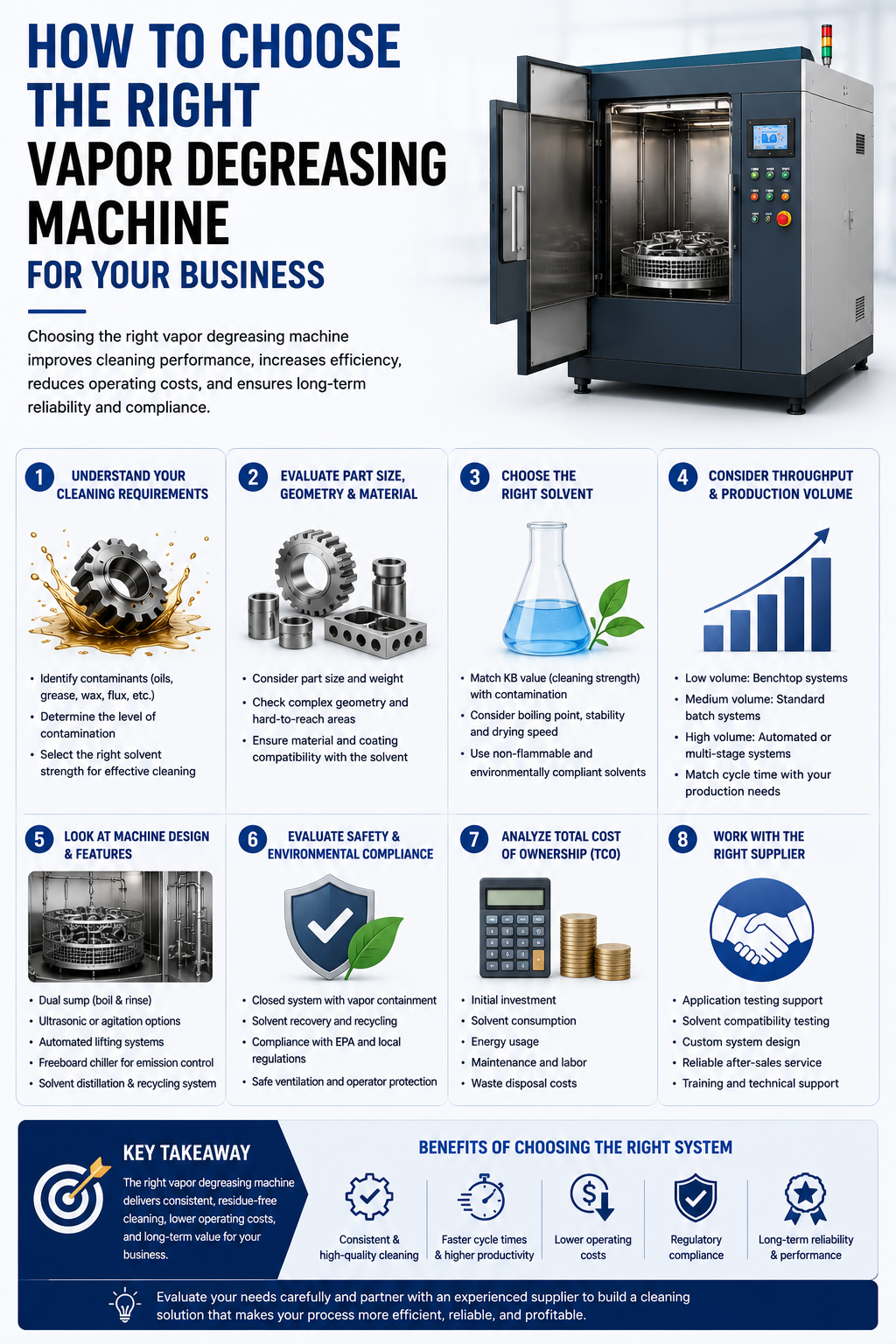 How to Choose the Right Vapor Degreasing Machine for Your Business
 How to Choose the Right Vapor Degreasing Machine for Your Business
Selecting the right vapor degreasing machine isn’t just about buying equipment—it’s about optimizing your entire cleaning process. The wrong choice can lead to poor cleaning results, higher operating costs, and compliance issues. The right system, on the other hand, can significantly improve efficiency, product quality, and ROI.
Here’s a practical, industry-focused guide to help you make the right decision.
🔹 1. Understand Your Cleaning Requirements
Start with the basics: what are you cleaning, and what needs to be removed?
Different contaminants require different cleaning strengths. Oils, grease, wax, flux residues, and particulates all behave differently. Choosing a system without matching it to your contamination profile is one of the most common mistakes.
Light contamination → simpler systems
Heavy grease or machining oil → stronger solvent + multi-stage system
Solvent selection is critical here. The cleaning power (often measured by solvency strength) must match the contamination level to avoid longer cycles and higher costs.
🔹 2. Evaluate Part Size, Geometry, and Material
Not all parts are equal. Consider:
Size and weight → determines tank size and load capacity
Complex geometry → requires better vapor penetration
Material compatibility → metals, plastics, coatings must not be damaged
Vapor degreasing excels at cleaning complex parts because solvent vapor can reach areas that water-based systems cannot.
Always verify that the solvent is compatible with all materials in your parts to avoid corrosion, swelling, or surface damage.
🔹 3. Choose the Right Solvent
The solvent is just as important as the machine itself.
Key factors to consider:
Cleaning strength (KB value) → matches contamination level
Boiling point → affects efficiency and drying speed
Non-flammability → critical for safety
Environmental compliance → must meet local regulations
An ideal solvent should dissolve contaminants quickly, remain stable under heat, and be safe to use in industrial environments.
🔹 4. Consider Throughput and Production Volume
Your production volume determines the type of machine you need.
Low volume / lab use → small benchtop systems
Medium production → standard batch degreasers
High-volume manufacturing → automated or multi-stage systems
Typical vapor degreasing cycles can be as short as 1–5 minutes per batch, making them highly efficient compared to aqueous systems.
🔹 5. Look at Machine Design and Features
Modern vapor degreasers offer a range of features that impact performance:
Dual sump systems (boil + rinse)
Ultrasonic or agitation options
Automated lifting systems
Freeboard chillers for emission control
Solvent recycling systems
A well-designed machine continuously distills and reuses solvent, improving cleaning consistency and reducing waste.
🔹 6. Evaluate Safety and Environmental Compliance
This is non-negotiable.
Make sure your system includes:
Proper vapor containment (cooling coils / chillers)
Closed-loop solvent recovery
Compliance with EPA or local environmental regulations
Safe ventilation and installation conditions
Modern systems are designed to minimize emissions and reduce operator exposure, making them far safer than older technologies.
🔹 7. Analyze Total Cost of Ownership (TCO)
Don’t just look at the purchase price.
Consider:
Solvent consumption
Energy usage
Maintenance requirements
Waste disposal costs
Labor savings
Vapor degreasing often has a lower long-term operating cost because it uses less energy and produces less waste compared to water-based systems.
🔹 8. Work with the Right Supplier
A good supplier does more than sell equipment—they help you optimize your process.
Look for:
Application testing support
Solvent compatibility testing
Custom system design
After-sales service and training
Choosing the right partner can make the difference between a system that “works” and one that truly improves your production efficiency.
🔹 Conclusion
Choosing the right vapor degreasing machine comes down to aligning your parts, contaminants, production needs, and compliance requirements with the right technology and solvent.
If you focus on:
Cleaning requirements
Part complexity
Solvent selection
Throughput needs
Safety and compliance
—you’ll not only choose the right machine, but also build a more efficient and reliable cleaning process.