


What Is an Ultrasound Tool in Industrial Cleaning?
 What Is an Ultrasound Tool in Industrial Cleaning?
 What Is an Ultrasound Tool in Industrial Cleaning?
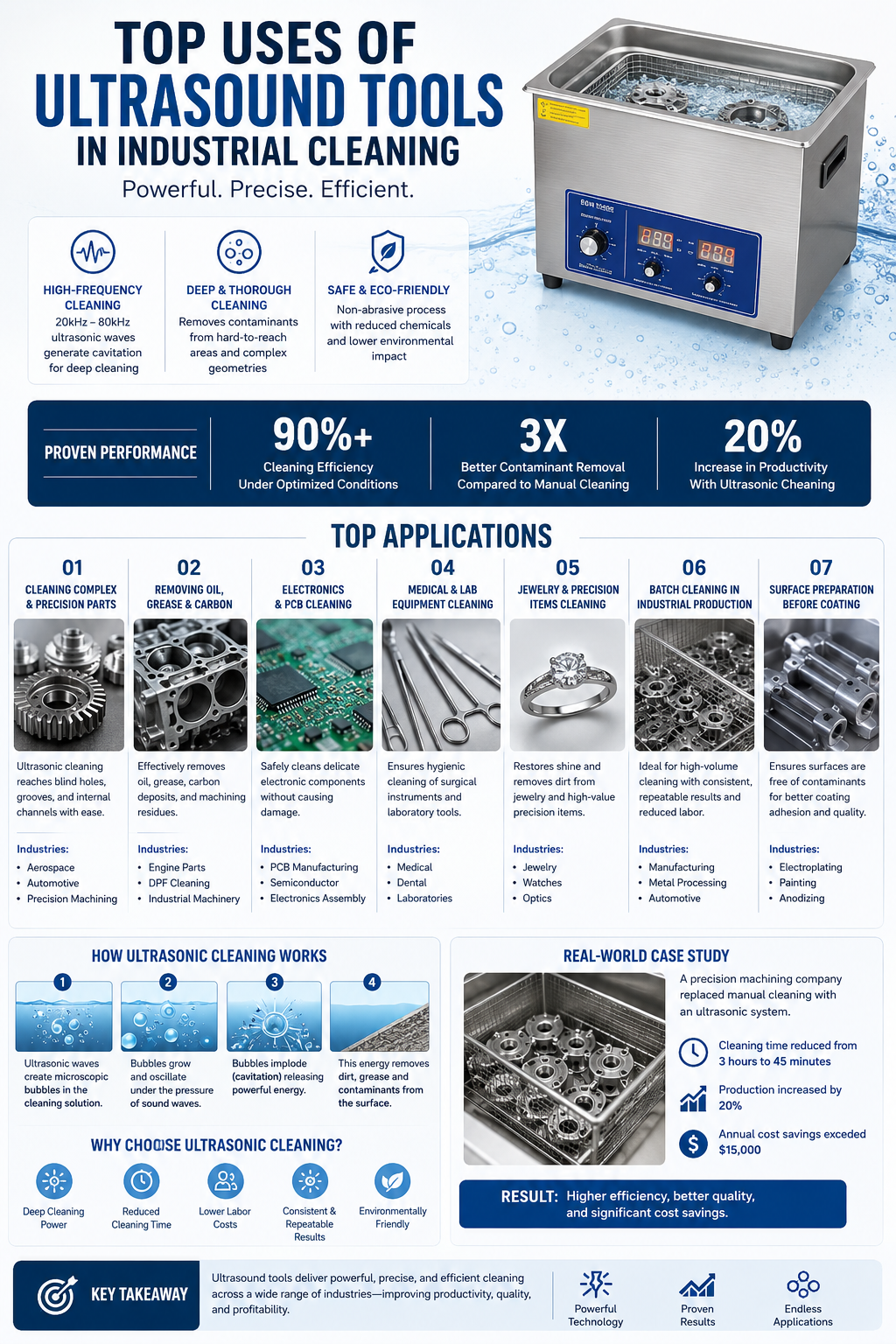
An ultrasound tool in industrial cleaning refers to equipment that uses ultrasonic waves (typically 20kHz–80kHz) to create microscopic bubbles in a liquid solution. When these bubbles collapse, they generate powerful cleaning energy that removes dirt, grease, and contaminants from surfaces.
👉 This process is known as cavitation, and it is the key to ultrasonic cleaning efficiency.
Top Uses of Ultrasound Tools in Industrial Cleaning
🔸 1. Cleaning Complex and Precision Parts
Ultrasonic cleaning is ideal for parts with blind holes, grooves, and internal channels.
📊 Data Insight:
Studies show ultrasonic cleaning can achieve over 90% cleaning efficiency for precision components.
👉 Industries:
Aerospace
Automotive fuel systems
Precision machining
🔸 2. Removing Oil, Grease, and Carbon Deposits
Ultrasound tools are highly effective at breaking down heavy contaminants such as oil, grease, and carbon buildup.
👉 Case Example:
A manufacturer cleaning engine components improved cleaning effectiveness by up to 3x compared to manual methods.
👉 Applications:
Engine parts
DPF cleaning
Industrial machinery
🔸 3. Ultrasonic Cleaning for Electronics and PCBs
For sensitive components, ultrasonic cleaning offers non-abrasive, high-precision cleaning.
👉 Removes:
Flux residues
Dust and particles
Oxidation layers
👉 Industries:
PCB manufacturing
Semiconductor production
🔸 4. Medical and Laboratory Equipment Cleaning
Ultrasound tools are widely used to clean surgical instruments and lab equipment.
👉 Benefits:
Reduces contamination risk
Improves sterilization effectiveness
Ensures consistent cleaning results
🔸 5. Jewelry and High-Value Parts Cleaning
Ultrasonic cleaning is a standard solution for jewelry and precision components.
📊 Data Insight:
Optimized ultrasonic systems can achieve near 100% contaminant removal in fine-detail cleaning applications.
🔸 6. Batch Cleaning in Industrial Production
Ultrasound tools support high-volume batch cleaning, making them ideal for manufacturing environments.
👉 Advantages:
Consistent quality
Reduced labor costs
Faster turnaround time
🔸 7. Surface Preparation Before Coating
Before plating or coating, parts must be completely clean.
👉 Ultrasonic cleaning ensures:
Better adhesion
Fewer defects
Higher product quality
👉 Used for:
Electroplating
Painting
Anodizing
Why Ultrasound Tools Improve Industrial Cleaning Efficiency
Ultrasonic cleaning systems offer several advantages over traditional methods:
Deep cleaning of hard-to-reach areas
Reduced cleaning time
Lower labor costs
Consistent and repeatable results
Environmentally friendly (water-based solutions)
Real-World Case Study
A precision machining company replaced manual cleaning with an ultrasonic system:
👉 Results:
Cleaning time reduced from 3 hours to 45 minutes
Production increased by 20%
Annual cost savings exceeded $15,000
This demonstrates how ultrasonic cleaning directly improves efficiency and profitability.
H2:Conclusion
Ultrasound tools have become essential in industrial cleaning due to their efficiency, precision, and scalability. Whether used for removing heavy grease or cleaning delicate electronics, ultrasonic technology delivers consistent, high-quality results.
For manufacturers looking to improve productivity and reduce costs, ultrasonic cleaning is no longer optional—it’s a competitive advantage.