


Benefits of Using Sonicator Ultrasonic Homogenizer ACE for Your Business
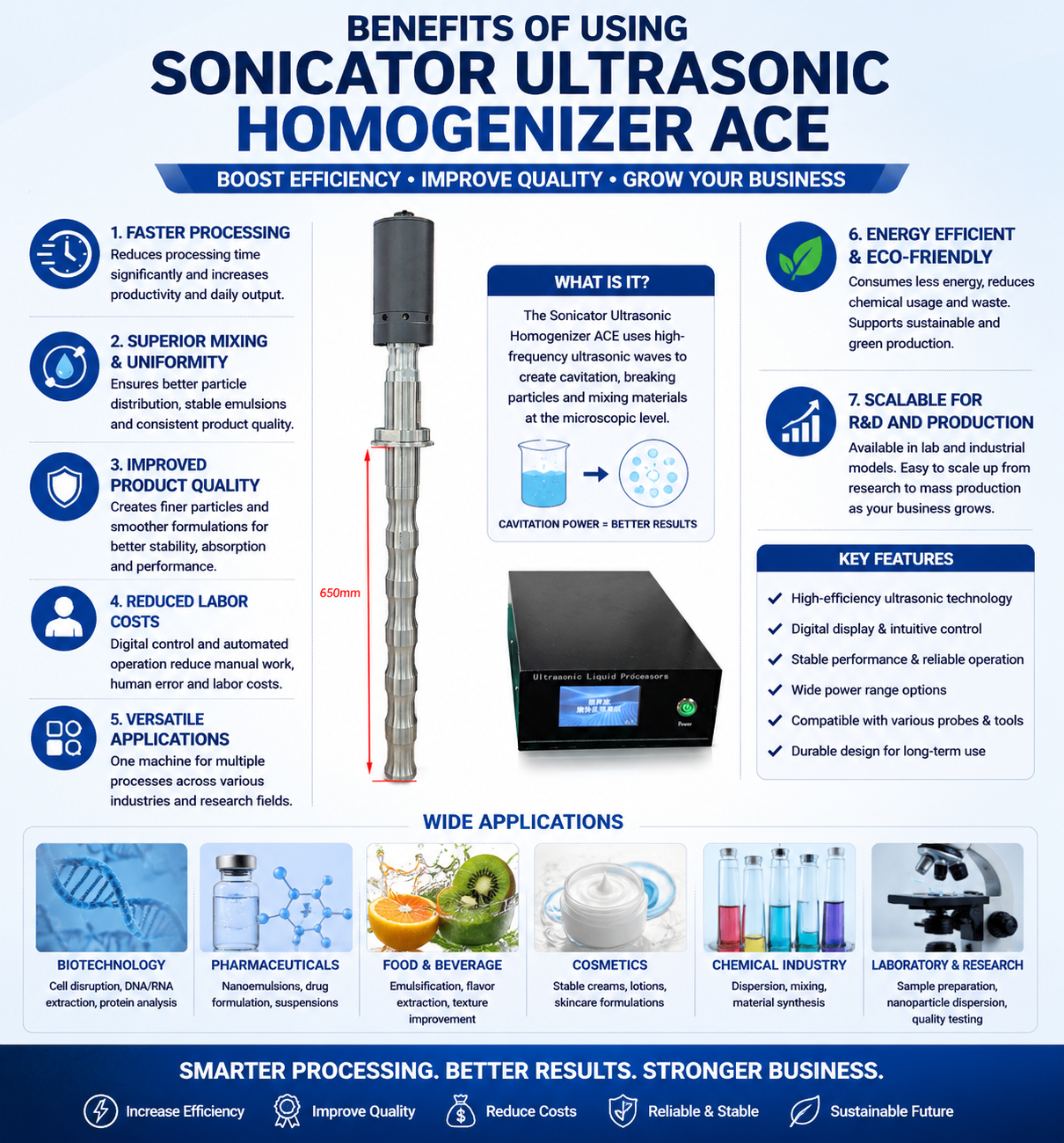 Benefits of Using Sonicator Ultrasonic Homogenizer ACE for Your Business
 Benefits of Using Sonicator Ultrasonic Homogenizer ACE for Your Business
In modern laboratories and industrial production environments, efficiency, consistency, and precision are critical. That’s why many companies are upgrading to advanced ultrasonic processing equipment such as the Sonicator Ultrasonic Homogenizer ACE. Whether you work in biotechnology, pharmaceuticals, cosmetics, food processing, or nanomaterial research, this technology can significantly improve productivity and product quality.
Ultrasonic homogenizers use high-frequency sound waves to break down particles, emulsify liquids, disperse nanoparticles, and accelerate laboratory processes. Compared with traditional mixing or mechanical homogenization methods, ultrasonic technology delivers faster and more uniform results.
What Is a Sonicator Ultrasonic Homogenizer?
A sonicator ultrasonic homogenizer converts electrical energy into ultrasonic vibrations through a transducer and probe system. These vibrations create microscopic cavitation bubbles inside liquids. When the bubbles collapse, they generate intense energy that can break particles apart and mix materials at the microscopic level.
This process is widely used for:
Cell disruption
Nano emulsification
Particle dispersion
Sample preparation
Chemical mixing
Extraction processes
Because of its precision and efficiency, ultrasonic homogenization has become an essential tool in modern research and industrial applications.
Key Benefits for Businesses
1. Faster Processing Speed
Traditional homogenization methods often require longer processing times and multiple production steps. Ultrasonic homogenizers can reduce processing time dramatically by generating powerful cavitation energy directly inside the liquid.
For laboratories and manufacturers, this means:
Higher production efficiency
Faster testing cycles
Increased daily output
Reduced operational delays
Businesses handling large sample volumes especially benefit from shorter processing times.
2. Superior Mixing and Uniformity
One major advantage of ultrasonic homogenization is its ability to create highly uniform mixtures.
The technology ensures:
Better particle distribution
Stable emulsions
Consistent product quality
Improved formulation stability
This is particularly important for industries such as cosmetics, pharmaceuticals, and food production where consistency directly affects product performance and customer satisfaction.
3. Improved Product Quality
Ultrasonic processing helps create finer particle sizes and smoother formulations. In many industries, smaller particles improve absorption, stability, and overall product effectiveness.
For example:
Cosmetic creams become smoother
Pharmaceutical suspensions become more stable
Nanomaterials disperse more evenly
Food emulsions achieve better texture
Higher product quality can help businesses strengthen brand reputation and reduce customer complaints.
4. Reduced Labor Costs
Most sonicator ultrasonic homogenizers feature digital controls, programmable settings, and automated operation. This reduces the need for constant manual supervision.
Benefits include:
Lower labor requirements
Reduced human error
Easier operation
More repeatable processing results
For businesses aiming to scale production efficiently, automation is a major advantage.
5. Versatile Applications
A Sonicator Ultrasonic Homogenizer ACE can support multiple business sectors, including:
Biotechnology
Used for DNA extraction, cell disruption, and protein analysis.
Pharmaceutical Industry
Ideal for nanoemulsions, drug formulation, and suspension preparation.
Food & Beverage
Used for emulsification, flavor extraction, and improving product texture.
Cosmetics
Helps produce stable creams, lotions, and skincare products.
Chemical Industry
Suitable for dispersion, mixing, and material synthesis.
Its flexibility allows businesses to use one machine for multiple processes.
6. Energy Efficient and Environmentally Friendly
Compared with some traditional mechanical processing methods, ultrasonic homogenization often consumes less energy and requires fewer chemical additives.
Advantages include:
Lower energy consumption
Reduced waste
Cleaner processing
Environmentally friendly production
As sustainability becomes increasingly important worldwide, ultrasonic technology supports greener manufacturing practices.
7. Scalable for Research and Production
Ultrasonic homogenizers are available in both laboratory and industrial-scale configurations. Businesses can start with smaller systems for R&D and later scale up for mass production.
This makes ultrasonic homogenization a smart long-term investment for growing companies.
Final Thoughts
A Sonicator Ultrasonic Homogenizer ACE offers businesses a powerful combination of speed, precision, efficiency, and versatility. From improving product consistency to reducing labor costs and increasing productivity, ultrasonic homogenization technology helps companies stay competitive in modern industrial markets.
For laboratories, manufacturers, and research facilities looking to improve operational efficiency and product quality, investing in ultrasonic homogenization equipment can provide significant long-term value.